FIU DNP residency and project hours: NGR 7892L through NGR 7942C
Florida International University (FIU) builds its DNP residency from four courses: the NGR 7892L Health Policy Practicum and three DNP Project courses, NGR 7940C, NGR 7941C and NGR 7942C, which together come to 540 hours. The graduate handbook treats 540 supervised hours as the floor and can add more for students with fewer than 1,000 post-baccalaureate practice hours.
Get your placement plan
Tell us your FIU program and where you live. A placement advisor replies with the preceptor and site options that fit your FIU course.
Four courses, 540 hours
The same four courses carry the residency for post-MSN students and for post-BSN to DNP students, but they land at very different points in the two plans. Post-MSN students start the project sequence in semester 4 of a 36-credit online program; post-BSN students reach it only after the MSN is awarded at the end of semester 6.
| Course | Title | Hours | Post-MSN DNP | Post-BSN, Fall start |
|---|---|---|---|---|
NGR 7892L | Health Policy Practicum | 40 | Semester 2 | Semester 2 |
NGR 7940C | DNP Project I | 170 | Semester 4 | Semester 8 |
NGR 7941C | DNP Project II | 165 | Semester 5 | Semester 9 |
NGR 7942C | DNP Project III | 165 | Semester 6 | Semester 10 |
On the Spring-start post-BSN plan, the three project courses fall in semesters 9 through 11. The DNP Nurse Anesthesia curriculum uses the same project numbers with 170, 160 and 160 hours, so check which plan a classmate is quoting before comparing totals.
The 540-hour floor and the 1,000-hour rule
The residency floor in FIU's graduate handbook is 540 supervised hours. It then looks at your practice history: a student who will have fewer than 1,000 post-baccalaureate practice hours at completion may need additional residency hours on top of the 540.
Your starting point is recorded at admission on the Verification of Post-Baccalaureate Clinical Practice Hours form. That form is the starting record for the rule, and any extra hours still need an approved organizational mentor and a site under contract, which takes time to arrange.
The handbook's DNP contact-hour formula assumes a 15-week semester. Work out the weekly load with your DNP residency faculty before the first project course opens, and share it with your mentor so the site knows what to expect.
If your verified post-baccalaureate hours may fall short of 1,000, ask the DNP Program Director before your first DNP Project course how many extra residency hours to plan for.
Post-BSN to DNP: 1,310 or 1,170 hours
FIU publishes two totals for the post-BSN to DNP. The DNP Clinical Education page gives 1,310 clinical hours for all four NP tracks (Adult-Gerontology Primary Care, Family, Pediatric and Psychiatric-Mental Health), the same figure for degree and post-master's certificate students. The plan of study page agrees on its Spring-start plan, but its Fall-start plan lists 1,170 hours for the Adult-Gerontology, Child and Psych tracks and 1,310 for Family.
The 140-hour gap matches the difference between the 770 MSN hours on FIU's web pages and the 630-hour minimum in the current handbook, and the 540 DNP residency hours are identical in both totals, so the disagreement traces back to the MSN portion. 770 versus 630 covers the MSN side, and the post-BSN to DNP page covers the rest of the program.
Ask your track program leader which total governs your cohort and keep the answer in writing.
How the residency is set up, step by step
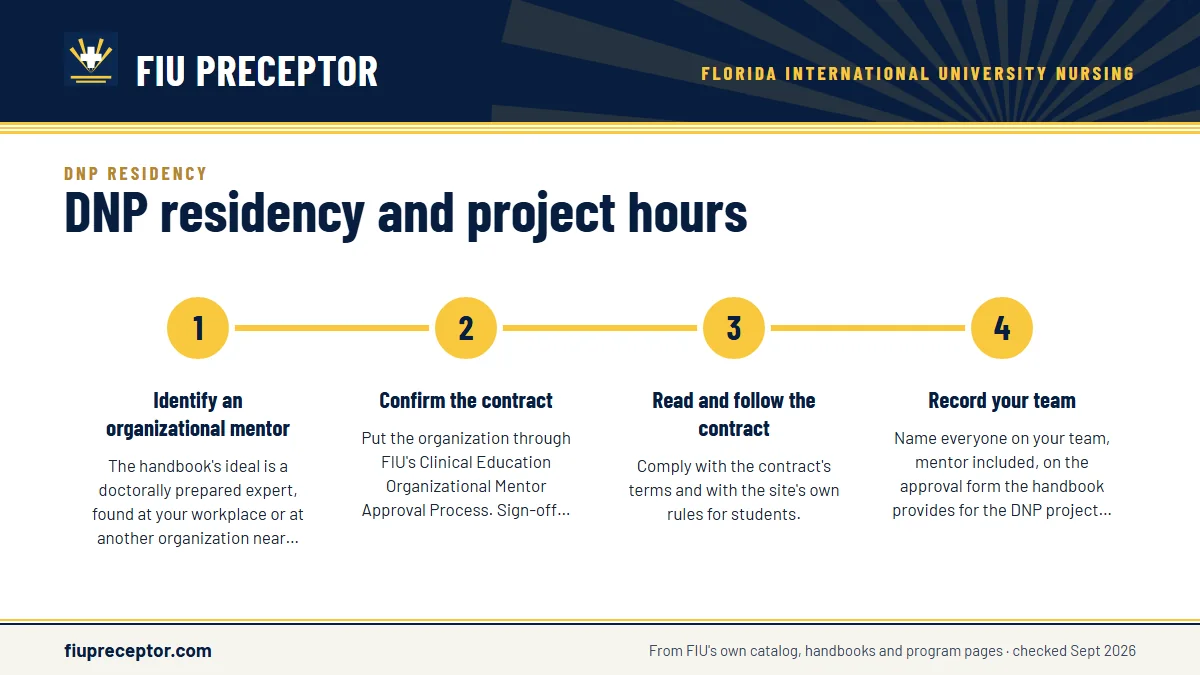
The handbook sets out a short sequence for residency hours, and every DNP student follows it, whichever door they entered by.
- Identify an organizational mentorThe handbook's ideal is a doctorally prepared expert, found at your workplace or at another organization near you. Choosing an organizational mentor covers who qualifies.
- Confirm the contractPut the organization through FIU's Clinical Education Organizational Mentor Approval Process. Sign-off comes from the DNP Program Director and from Clinical Education, and the contract is held by FIU, not by you.
- Read and follow the contractComply with the contract's terms and with the site's own rules for students.
- Record your teamName everyone on your team, mentor included, on the approval form the handbook provides for the DNP project and its team.
Among the course choices on the Preceptor Request Form (2022 manual) are DNP Residency 1, 2 and 3, so mentor details reach FIU on the same form NP students use. Residency time at your employer counts only when it is extra to your normal job and falls outside your regular work schedule; see working where you work.
Grades, repeats and the clock on the project courses
The project courses carry their own failure limit. FIU's graduate handbook allows only one failure across NGR 7940, NGR 7941 and NGR 7942, and it also sets a dismissal rule for failing two courses anywhere in the program. The handbook's wider repeat rules conflict with the catalog, as grades and progression shows. A late drop is no escape hatch either, since the handbook converts two DRs in one course into a failure.
Time limits are the other pressure. The handbook's Dismissal Guideline gives the post-MSN DNP 4 years and the post-BSN DNP 6, while its Degree Completion Timeline and university policy 380.080 give doctoral students 9. Time spent searching for a replacement mentor comes out of that window, so plan to the shorter limit.
Online study with some campus time
FIU Online describes the post-MSN DNP as 36 credits of online coursework plus a clinical residency and a capstone project, with a part-time format available on request and approval. The same FIU Online page says the program may include up to three on-campus class sessions per semester.
On the MSN FAQ page, FIU calls the Traditional DNP completely online, with the caveat that faculty may request campus meetings for testing. The two statements do not match. If you live far from the Modesto A. Maidique Campus, ask the DNP Program Director how many campus sessions your residency semesters will require before you book travel. On the Fall cohort plan, the six semesters put the Health Policy Practicum in the second and the three project courses in the last three, so those are the terms to check.
How we help FIU DNP students with the residency
The residency is only as strong as the organizational mentor behind it. We find mentor candidates whose organizations fit your project topic, learn at the start whether an FIU contract is already in place there, and prepare the details FIU's approval process asks for, so contract time does not eat into your project semesters.
Mentor and site approval belongs to the DNP Program Director and FIU's Clinical Education Department, and the packet we help you send them is thorough, tidy and aligned with FIU's process on the first try. We stay with you through NGR 7942C and act fast if a mentor steps away. Tell us your project topic, your county and the semester your project courses begin, and we build the mentor search around those three facts. Use the form below to start.
Questions FIU students ask
How many clinical hours is FIU's post-MSN DNP?
The FIU Online plan lists 540: 40 hours in NGR 7892L Health Policy Practicum and 170, 165 and 165 hours in the three DNP Project courses. The graduate handbook treats 540 supervised hours as the minimum and may add more if you will have fewer than 1,000 post-baccalaureate practice hours at completion, so your own total can be higher.
Why might FIU require more than 540 residency hours?
The handbook ties the residency to your overall practice history. Students with fewer than 1,000 post-baccalaureate practice hours at completion may need additional residency hours. Your verified hours come from the form you filed at admission, so ask the DNP Program Director early how that figure affects your plan.
When do post-BSN students start the DNP Project courses?
On the Fall-start plan, NGR 7940C falls in semester 8, NGR 7941C in semester 9 and NGR 7942C in semester 10, after the MSN is awarded at the end of semester 6. On the Spring-start plan, the three project courses run in semesters 9 through 11. NGR 7892L comes much earlier, in semester 2 of the Fall plan.
Can I complete FIU DNP residency hours at my own job?
Yes, within limits. Residency work at your employer must sit outside your usual duties and your scheduled shifts, and whoever supervises you day to day cannot be your mentor. The workplace also needs an FIU contract, and the rotation still goes to the DNP Program Director and Clinical Education for approval.
Related pages
Last checked 2026-09-26
We check these pages against FIU's own graduate handbook, preceptor manual, plans of study, catalog and licensure pages. Your plan of study, your course faculty, your clinical faculty and FIU's Office of Clinical Education have the final word.
FIU asks you to identify your clinical site. We make that the easy part.
Tell us your FIU track, where you live and which semester your next practicum starts. We find preceptors whose patients fit the course, check early whether the site already holds an FIU contract, and prepare everything the Preceptor Request Form asks for.
- Preceptors matched to the course: adult and older-adult primary care for
NGR 6201L, pediatric primary care forNGR 6301L, an organizational mentor forNGR 7940C - Preceptor, facility, license and schedule details ready for the Preceptor Request Form, weeks ahead of the contract clock
- Across Miami-Dade, Broward, Palm Beach and Monroe, or beyond them where FIU approves your site
Start your placement plan
Track, city and semester is all we need to begin.