FIU's MSN Adult-Gerontology Primary Care NP: your clinical sites
Florida International University (FIU) delivers its MSN Adult-Gerontology Primary Care NP (AGPCNP) track predominantly online, and its Clinical Education page leaves no doubt about placements: finding the clinical site falls to you, while FIU's clinical department steps in to arrange the contract. Three practicums in adult and older-adult primary care depend on that search. We run it for you and hand FIU a complete, well-matched site.
Plan your AGPCNP practicums
Tell us your city and the semester of your first practicum.
What FIU asks of AGPCNP students
FIU answers the question on its MSN Clinical Education page. The college's clinical department helps graduate students one-on-one with placements in general, but for its two online tracks, Adult-Gerontology and Pediatric Primary Care, the page calls identifying the site "the student's responsibility" and asks you to work alongside the clinical department, which then arranges a contract with the practice. Until that contract is signed, the rotation stays on hold.
Because the track is online, your sites can sit outside the four counties FIU has long trained in: Monroe, Miami-Dade, Broward and Palm Beach. That helps if you live in Orlando or Tallahassee, but a practice that far out may never have signed an FIU agreement, which adds weeks to the timeline.
An older document, FIU's 2022 preceptor manual, told graduate students to leave preceptor and site contact to the school. For the online tracks, today's Clinical Education page is the instruction that counts, and our online vs hybrid tracks page compares the two. Either way, your course faculty and the Office of Clinical Education sign off on each site and preceptor.
The AGPCNP program at a glance
In short: two years, 47 credits and three primary care practicums in the second year, every one of them built on a site you identify.
| Item | What FIU publishes |
|---|---|
| Delivery | Predominantly online; 1-3 campus visits per semester may be required |
| Credits | 47 on the MSN overview page |
| Length | Six semesters over two years, full time |
| Start term | Fall only; applications November 1 to February 1 |
| Home base | Modesto A. Maidique Campus, AHC 3, Miami |
| Practicums | NGR 6201L, NGR 6202L, NGR 6203L (plan revised 5-2026) |
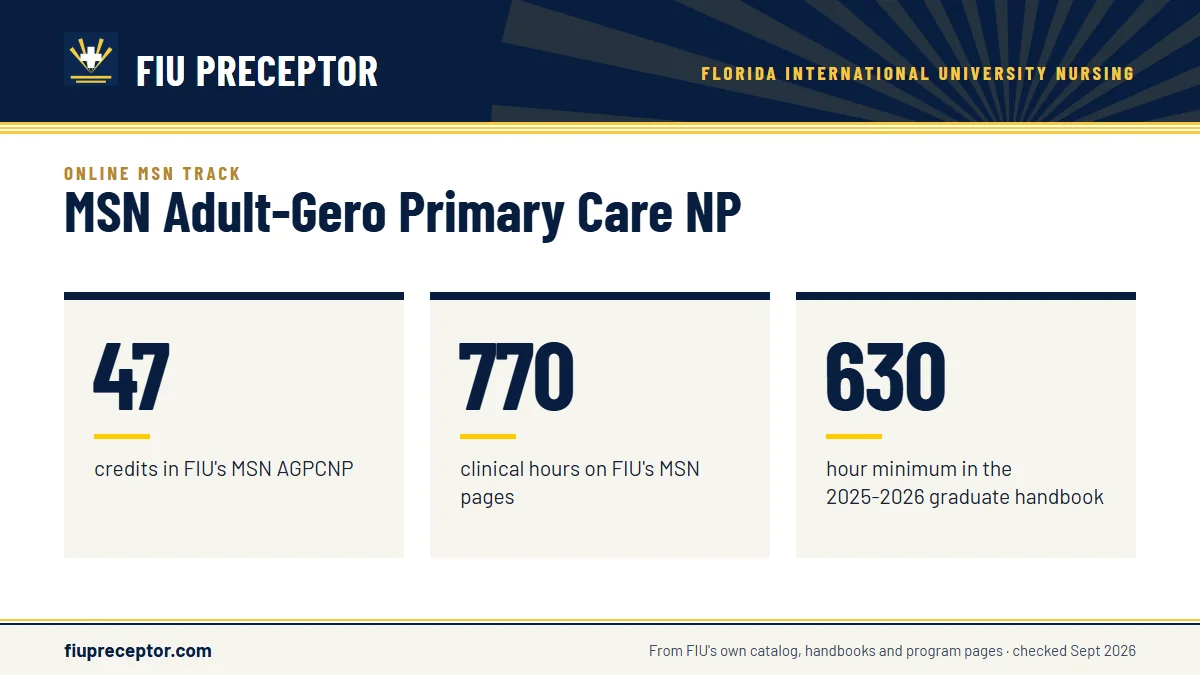
| Clinical hours | 770 on the web pages; 630 minimum in the handbook |
| After graduation | Eligible to apply for national certification and Florida APRN certification |
FIU's FAQ rules out a semester off except through a Leave of Absence granted individually, and the published plan is full time. With that fixed pace, a late site search is costly: miss one practicum semester and the sequence, and your graduation with it, can slide back a full year.
Semester by semester, and when the search starts
The practicums fall in the second year, but the preparation starts in the first. FIU's plan of study, revised 5-2026 and effective Spring 2027, lays out the AGPCNP sequence like this.
| Semester | Courses | Credits |
|---|---|---|
| 1 Fall | NGR 5110 Theories in Nursing; NGR 5141 Pathophysiologic Concepts; NGR 5810 Research Methods in Nursing | 9 |
| 2 Spring | NGR 6002C Advanced Health Assessment; NGR 6172 Pharmacological Concepts; NGR 5131 Culture in Advanced Nursing Practice | 10 |
| 3 Summer | NGR 6743 Clinical Education Seminar; NGR 5064C Diagnostics & Therapeutics; NGR 6703 Role Development | 6 |
| 4 Fall | NGR 6201 with the NGR 6201L practicum (4 cr) | 7 |
| 5 Spring | NGR 6202 with the NGR 6202L practicum (4 cr) | 7 |
| 6 Summer | NGR 6203 with the NGR 6203L practicum (3 cr); NGR 6744 Professional Advanced Practice Seminar | 8 |
Rotations at FIU are arranged in the term before each clinical course, with faculty and students sharing the work, so the NGR 6201L site gets settled in the third-semester summer next to the NGR 6743 seminar. A practice with no FIU contract needs 6-8 weeks for a new one under the current handbook, which pulls the real search back into your first spring.
There is also a recency gate. Your grades in NGR 6002C, NGR 5141 and NGR 6172 must be a B or higher and no more than 3 years old when a clinical course begins. The full-time plan meets that without effort; after a leave, recheck the dates.
770 or 630 clinical hours: the AGPCNP conflict
This track has two published totals. On the Clinical Education page and in the plan of study, AGPCNP carries 770 clinical hours. The 2025-2026 Graduate Nursing Student Handbook (Rev. April 30, 2026) instead names 630 as the floor for Adult-Gerontology, Pediatric and Psychiatric-Mental Health students, and reserves 770 for Family NP students.
A third FIU document leans toward the handbook. The post-BSN to DNP Fall plan lists 1,170 total hours for the Adult-Gero, Child and Psych specialties against 1,310 for Family, a gap of exactly 140 hours, the same distance that separates 770 from 630.
FIU publishes no per-course split for NGR 6201L, NGR 6202L or NGR 6203L, so only your faculty can say how the total divides by semester. Check your plan of study first, then raise the question with your clinical and course faculty and, if needed, the Office of Clinical Education, all before the first practicum. While you wait, recruit a preceptor with room for the larger number. 770 vs 630 hours compares every source.
Ask your faculty in writing which total applies to your cohort, and keep the reply with your plan of study.
Two versions of the practicum sequence
The plan of study and the handbook also describe the practicums differently. The 5-2026 plan gives three practicums, each paired with a theory course, and closes with NGR 6744 in the final summer. Each has its own page: NGR 6201L, NGR 6202L and NGR 6203L.
The current handbook has only two practicums, Advanced Adult-Gerontology Nursing I and II, followed by a clinical decision making course (NGR 6209) and a role synthesis course (NGR 6700L). FIU's 2021 brochure used that older layout too, and the Preceptor Request Form, revised in 2022, still offers Clinical Practicum-I, Clinical Practicum-II and Role Synthesis as its course choices.
If you entered before Spring 2027, check with your Graduate Nursing Advisor or track program leader about which layout applies to you. It decides which course you name on each semester's request, and what your last preceptor is signing up for.
The preceptor an AGPCNP practicum needs
The practicums build skill with adults and older adults, so look for a preceptor whose day is spent seeing those patients in a primary care office. The handbook wants a year or more of experience in the specialty, a current license and national certification, and FIU weighs each candidate's education, NP or CNS credential, nursing philosophy and readiness to teach.
Physicians are allowed to precept FIU students, even though the same handbook also calls for a master's in nursing, a contradiction FIU has not resolved; in practice, nurse practitioners supervise most rotations. Relatives and close friends cannot serve, and neither can a preceptor on your own unit, although another unit in a large institution is acceptable. Expect daytime weekday rotations, roughly a 9-to-5 schedule, as the handbook tells primary care students.
Why AGPCNP students choose us
We are built around FIU's process for this exact track. You tell us your city, your cohort and the practicum semester; we find adult-gero primary care preceptors near you who have room for an FIU student, and we confirm the fit before your request ever reaches FIU.
Next we assemble each item FIU's request form wants: the preceptor's name and specialty, the facility and its address, an email, license details, the term's dates and your clinical days and hours. Whether the practice already has an FIU agreement is something we find out at the start, so any new contract begins well inside its 6-8 week window. Your Complio or FIU Express clearance and Typhon's seven-day logging deadline stay on our list, and if a preceptor drops partway through the sequence, we line up the next one.
Your faculty and FIU's Office of Clinical Education have the final say on every site and preceptor. What we control is the quality of what lands on their desk: complete, accurate and in line with FIU's rules from the first submission. Read how it works, or start with the form at the bottom of this page.
Questions FIU students ask
Is FIU's AGPCNP program completely online?
Not completely. FIU calls the track predominantly online: coursework is online, but 1-3 visits to campus may be required each semester, and your clinical hours happen in person at an approved site. The campus is the Modesto A. Maidique Campus in Miami, so budget travel time if you live elsewhere in Florida.
Can I do AGPCNP clinicals in another state?
FIU permits online-track students to train beyond its four home counties in South Florida, yet it is silent on other states. Its licensure page says the MSN satisfies Florida's requirements and leaves every other state undetermined. Before you contact an out-of-state practice, check with the Office of Clinical Education, and keep the answer in writing.
Does the FIU MSN AGPCNP require a thesis or research project?
FIU's documents disagree. The MSN FAQ offers a choice of thesis, master's paper or research practicum; the handbook's core includes a research project course, NGR 6910C; and the 5-2026 plan of study has no research course. Your Graduate Nursing Advisor can tell you which rule your cohort follows, so ask before your final year.
Which certification exam do FIU AGPCNP graduates take?
FIU says its graduates are eligible to seek national certification in their specialty and Florida APRN certification, and that passing the national exam meets the Board of Nursing's criteria for APRN licensure. FIU names no certifying body, so ask your track program leader. The handbook also expects a certification review course in the year before you sit the exam.
Can I take a semester off from the AGPCNP track?
Only through a Leave of Absence, which FIU handles case by case. The plan runs six straight semesters from a Fall start, and the handbook can dismiss students who are not enrolled for more than two consecutive semesters of the plan. A leave does not stop the degree clock, so talk to your advisor before a missing preceptor tempts you to sit a semester out.
Related pages
Last checked 2026-09-26
We check these pages against FIU's own graduate handbook, preceptor manual, plans of study, catalog and licensure pages. Your plan of study, your course faculty, your clinical faculty and FIU's Office of Clinical Education have the final word.
FIU asks you to identify your clinical site. We make that the easy part.
Tell us your FIU track, where you live and which semester your next practicum starts. We find preceptors whose patients fit the course, check early whether the site already holds an FIU contract, and prepare everything the Preceptor Request Form asks for.
- Preceptors matched to the course: adult and older-adult primary care for
NGR 6201L, pediatric primary care forNGR 6301L, an organizational mentor forNGR 7940C - Preceptor, facility, license and schedule details ready for the Preceptor Request Form, weeks ahead of the contract clock
- Across Miami-Dade, Broward, Palm Beach and Monroe, or beyond them where FIU approves your site
Start your placement plan
Track, city and semester is all we need to begin.