How we find your FIU preceptor, step by step
Florida International University (FIU) asks those enrolled in its online primary care NP tracks to identify their own clinical site, and its clinical department then helps set up the contract with that site. We run the search for you: preceptors near home whose patients fit your FIU course, screened against FIU's rules, with every detail the Preceptor Request Form needs gathered well before the semester your practicum begins.
Get your placement plan
Tell us your FIU program and where you live. A placement advisor replies with the preceptor and site options that fit your FIU course.
What you send us, and what comes back
Four facts start a search: your FIU track, the practicum course that needs a site (for example NGR 6201L or NGR 6301L), the city or ZIP code you can reach on weekdays, and the term the course begins. Add your employer and unit, because FIU's graduate handbook rules out rotations on the unit where you work, and name any clinician you have already approached so no one is contacted twice.
Your placement advisor replies with preceptor options that suit the course and your commute. Each one has been screened against FIU's standards, and each comes with a plain note on whether the practice already holds an FIU contract. Once you choose, the preceptor and site details arrive in the same order as FIU's request form, so your faculty can sign without a second round of questions.
The steps, from first message to first clinical day
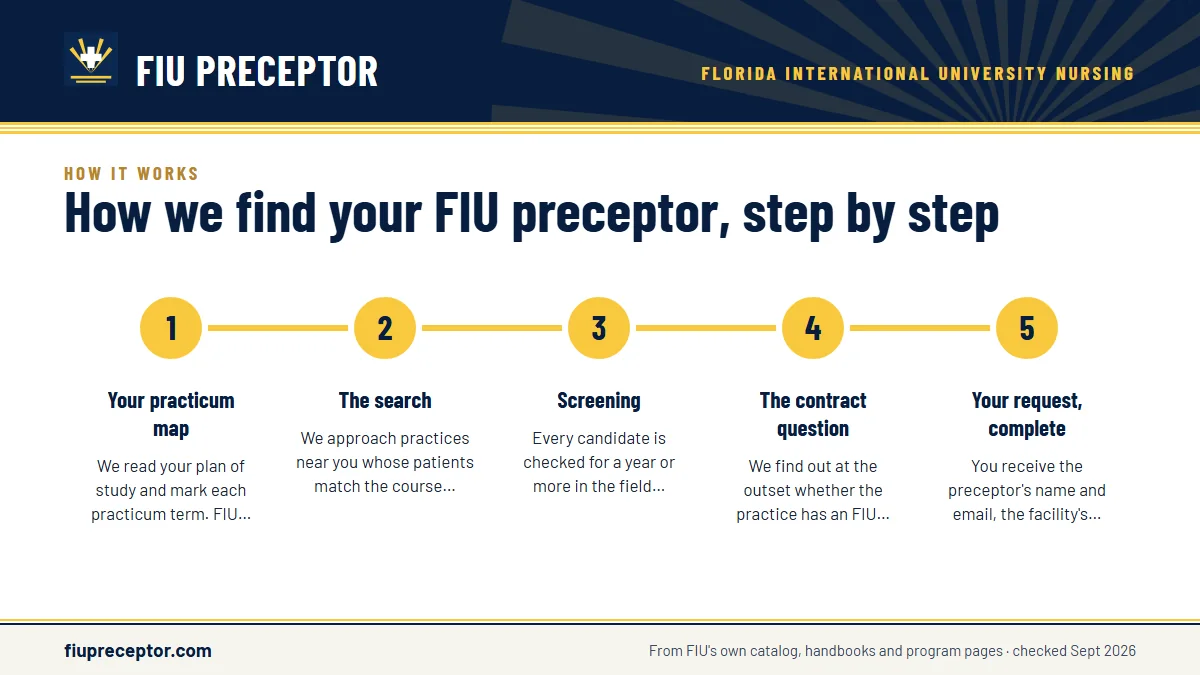
- Your practicum mapWe read your plan of study and mark each practicum term. FIU arranges each rotation during the term ahead of the course, which puts the work for a Spring 2027 practicum (classes begin January 11) squarely in Fall 2026.
- The searchWe approach practices near you whose patients match the course: adults and older adults in primary care for the AGPCNP practicums, children in primary care for the PNP practicums, and an organizational mentor for the DNP residency.
- ScreeningEvery candidate is checked for a year or more in the field, active licensure and national certification, plus a Florida license when the site is in Florida. Relatives, close friends and your own unit are ruled out.
- The contract questionWe find out at the outset whether the practice has an FIU agreement on file. When it has none, the clinical department needs lead time, 6-8 weeks in the current handbook, and your calendar is built around that.
- Your request, completeYou receive the preceptor's name and email, the facility's name and address, the specialty, the license number with its expiration date, and the clinical days and hours you agreed, all laid out for the Preceptor Request Form.
- FIU's reviewYour faculty sign the form and FIU's Office of Clinical Education confirms the site and preceptor have every required contract and document. Your first day comes after both.
- On call all semesterIf a preceptor steps away, a replacement search starts the same day, with your Typhon, clearance and schedule dates kept in view.
Who handles each part
Three parties share a placement: you, our placement desk and FIU. Keeping the lines clear saves time, because FIU's approvals cannot be skipped and your own tasks cannot be delegated to a preceptor.
| Task | Who handles it |
|---|---|
| Finding and screening preceptors near you | Our placement desk |
| Choosing among the preceptor options | You, from our shortlist |
| Gathering the Preceptor Request Form details | Our placement desk, for you to submit |
| Signing the request | Your faculty |
| Confirming the site and preceptor | FIU's Office of Clinical Education and faculty |
| Setting up a new site contract | FIU's clinical department |
| Clearance in Complio or FIU Express | You, with renewal dates tracked by us |
| Logging each clinical day in Typhon NPST | You, then your preceptor and faculty approve |
| A replacement if a preceptor drops | Our placement desk |
Matching the preceptor to your FIU course
A preceptor is only useful if the patients fit the course. For the adult-gerontology practicums that means an internal medicine, family or senior-focused primary care practice; for the pediatric practicums, a pediatric primary care office. The AGPCNP track and PNP track guides show where each practicum falls in your plan.
DNP students need something different: an organizational mentor, ideally doctorally prepared and expert in the field, who is not your regular work supervisor. For RN to BSN students, FIU's BSN handbook advises looking inside your own facility, for a BSN-prepared nurse who works off your own unit.
Schedule fit matters as much as specialty. FIU's handbook tells primary care students to expect Monday to Friday rotations between 9:00 a.m. and 5:00 p.m., so we look for clinicians whose clinic days line up with your work and family commitments before anyone commits.
Why the search starts a semester early
FIU's calendar sets the pace. Your faculty and you plan each rotation one term ahead, a site without an FIU agreement needs one before your first day, and clearance has to be finished before the rotation opens. Your detailed schedule then goes to your clinical faculty by the first week of clinical seminar, so the preceptor's days must be settled before that week arrives.
For a Summer 2027 practicum in Session C, which opens May 10, that means a confirmed preceptor during the Spring term, early enough for a new contract if one is needed. The semester-before plan lays out the months. If your start date is already close, the fast-start guide explains how a compressed search runs and what to tell your faculty while it does.
Why FIU students choose us
We are the most thorough way to meet FIU's site requirement on the online tracks, because every step is built around FIU's own process. You get clinicians near home whose patient panels suit the course, met in person, and a request that arrives at FIU with nothing missing. The contract status is known early, the lead time is planned in, and the 7-day Typhon rule and clearance renewals stay on your radar.
Approval of each site and preceptor rests with FIU's Office of Clinical Education and your clinical faculty. Our part is a request they can review in one pass: complete, accurate and inside FIU's rules. If plans change mid-semester, your placement advisor is already working on the next option. Tell us your track, course, city and start term in the form below to begin.
Questions FIU students ask
How long does it take to find an FIU preceptor?
It depends on the course, where you live and whether the site already holds an FIU contract. Plan on the semester before your practicum, since that is when FIU arranges rotations, and remember that a brand-new site agreement needs 6-8 weeks by the current graduate handbook's count. Share your start term and we set the dates backward from it.
Do I still submit the Preceptor Request Form myself?
Yes. The request goes to FIU from you, with your faculty's signature, and FIU staff then note when the site was last evaluated and check the preceptor's license. We supply every detail the form asks for so nothing comes back for correction, and the Preceptor Request Form guide walks through each field.
Can you help if my practicum semester has already started?
Yes, and speed matters. FIU allows no rotation before the contract is in place, so the first check is whether a candidate site already holds an FIU agreement. The guide for students with no preceptor covers what to tell your faculty while the search runs.
Do you help FNP and PMHNP students on the hybrid tracks?
Yes. On those tracks FIU's clinical department works with each student one-on-one on placement, and the graduate nursing clinical coordinator serves as the main point of contact. Hybrid-track students come to us when they want a site closer to home or a gap opens; keep the coordinator informed of any site you propose.
What happens if FIU does not approve the preceptor I chose?
Your placement advisor returns to the shortlist and widens the search at once. The decision sits with FIU's clinical education office and your faculty, and whatever they flag shapes the next options, whether that is a different specialty, a site with an existing contract or a preceptor with longer experience.
Related pages
Last checked 2026-09-26
We check these pages against FIU's own graduate handbook, preceptor manual, plans of study, catalog and licensure pages. Your plan of study, your course faculty, your clinical faculty and FIU's Office of Clinical Education have the final word.
FIU asks you to identify your clinical site. We make that the easy part.
Tell us your FIU track, where you live and which semester your next practicum starts. We find preceptors whose patients fit the course, check early whether the site already holds an FIU contract, and prepare everything the Preceptor Request Form asks for.
- Preceptors matched to the course: adult and older-adult primary care for
NGR 6201L, pediatric primary care forNGR 6301L, an organizational mentor forNGR 7940C - Preceptor, facility, license and schedule details ready for the Preceptor Request Form, weeks ahead of the contract clock
- Across Miami-Dade, Broward, Palm Beach and Monroe, or beyond them where FIU approves your site
Start your placement plan
Track, city and semester is all we need to begin.