FIU Adult-Gerontology Acute Care NP (AGACNP): MSN and certificate clinicals
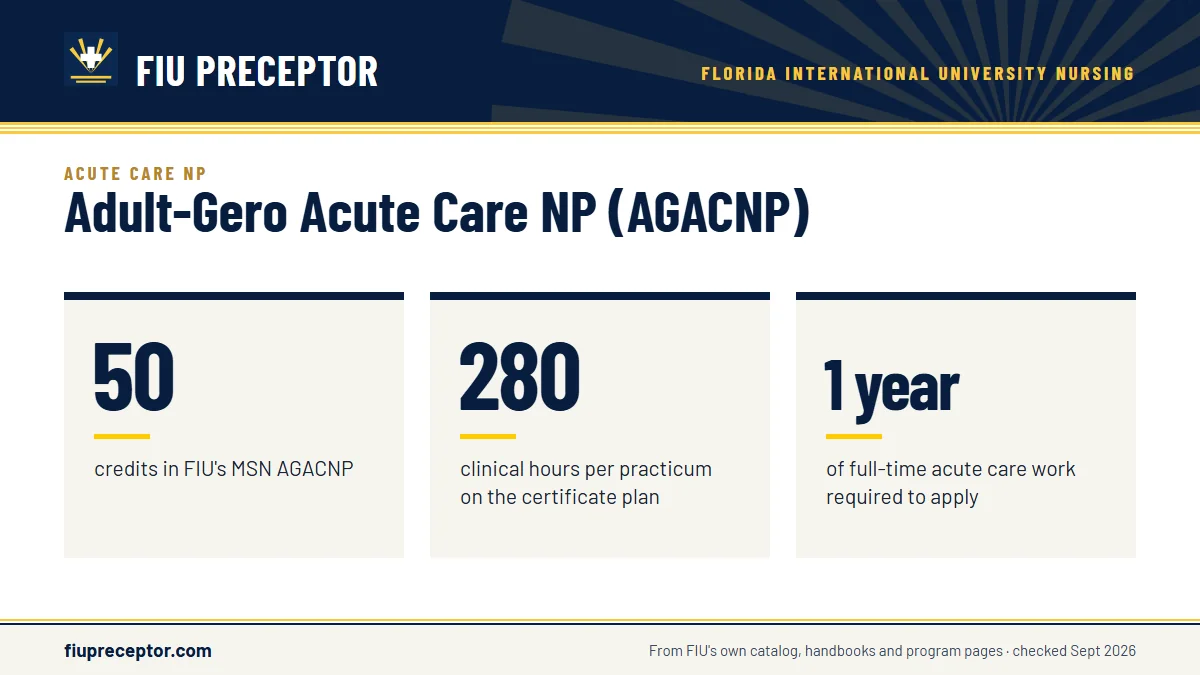
Florida International University (FIU) offers the Adult-Gerontology Acute Care NP as a 50-credit MSN and as a 35-credit hybrid post-graduate certificate, built on the practicums NGR 6210L, NGR 6211L and, on most FIU documents, NGR 6213L. Acute care rotations can run evenings, nights and weekends. FIU's clinical department assists with placements; we find hospital-based preceptors you can suggest, and we step in fast if one drops.
Get your placement plan
Tell us your FIU program and where you live. A placement advisor replies with the preceptor and site options that fit your FIU course.
Getting in: the acute care work rule
FIU's AGACNP asks for more than a license. MSN admission requires at least 1 year of full-time employment in acute care, and FIU prefers critical care, intermediate care, progressive care or step-down experience. That background shapes your rotations too, because your faculty and preceptors can build on a bedside acute care base.
FIU's own pages describe the track unevenly. The MSN page gives no delivery label for AGACNP, while the certificate page calls it hybrid. The MSN page also says FIU has four specialty tracks yet lists five, and the MSN FAQ leaves AGACNP out. Confirm your entry term and format with the Graduate Nursing Advisor before you plan anything else.
A Pediatric Acute Care NP certificate also appears on FIU's certificate page, as a hybrid track with its own practicums (listed as 6XXXL, NGR 6332L and NGR 6333L) at 280 hours each.
The MSN plan and the certificate plan
Both routes use the same acute care practicums, but FIU's documents do not agree on the third one. The table lines up the 5-2026 MSN plan of study, effective Spring 2027, against the certificate plan.
| Course | MSN plan (5-2026) | Certificate plan |
|---|---|---|
NGR 6210L Practicum I | Semester 4, with NGR 6210 and NGR 5063C | 280 clinical hours |
NGR 5063C Diagnostics & Procedures for Acute Care | Semester 4 | 64 indirect clinical hours |
NGR 6211L Practicum II | Semester 5, with NGR 6211 | 280 clinical hours |
NGR 6213L Practicum III | Marked with a dash for AGACNP, though semester 6 still totals 8 credits | 280 clinical hours, then NGR 6744 |
The graduate handbook and the certificate plan both include NGR 6213/NGR 6213L. If your MSN plan shows the dash, ask your track program leader which final course you take before a preceptor is booked for semester 6.
Certificate students also attend a mandatory Clinical Placement Orientation in April-May, before clinical rotations begin. Put it on your calendar the moment you are admitted.
Hours: 770, 630 or 280 per practicum
FIU publishes three different pictures of AGACNP hours. The MSN Clinical Education page gives 770 for every NP track. The current graduate handbook sets a lower floor of 630 hours for Adult-Gerontology students, acute as well as primary care. The certificate plan assigns 280 clinical hours to each of its three practicums. On the MSN side, FIU gives no hour figure for each practicum; only the certificate plan breaks hours out course by course.
FIU does not reconcile these, so treat the number as open until someone confirms it. Get your cohort's figure in writing from your plan of study or your faculty before a preceptor commits to a shift schedule. The 770 vs 630 explainer and the clinical hours hub compare every program's figures.
Evenings, nights and weekends
Acute care follows the hospital clock. FIU's handbook tells acute care students their rotations can fall on evenings, nights and weekends, a contrast with the weekday daytime pattern it sets for primary care. If you still work acute care shifts yourself, the real task is fitting two schedules together.
A few FIU rules frame the shift puzzle. Hours count only inside the official semester, and any shift during a campus break needs your faculty's written OK by email beforehand. Lock the pattern with your preceptor before day one; your clinical faculty expect the full schedule as seminar opens.
Night and weekend shifts bring their own traps. Any shift you miss has to be repaid in full, and FIU treats arrival more than 5 minutes after the start as tardy, which can end your day early. A shift scheduled on an official holiday moves to a replacement day agreed with your preceptor, and in hurricane season only official university closures excuse you.
Your own hospital, and what large systems ask
Your own unit is closed to you for rotations, though FIU may approve a separate unit inside a large hospital. The rule bites hardest in acute care, since every AGACNP student arrives with acute care employment behind them, often at a hospital that could otherwise host a rotation. Details sit on the working where you work page.
Hospital systems then add layers of their own, and their public pages do not mention FIU either way. At Baptist Health South Florida, only partner schools holding both a Master Agreement and a Program Letter of Agreement can request rotations; the student needs a preceptor and placement confirmed first, a Complio profile goes in 10 or more business days before the start, and staff cannot rotate in the facility that employs them. Cleveland Clinic Florida arranges advanced practice placements only through an academic representative after an affiliation agreement, via its Office of Advanced Practice.
Florida's Board rule 64B9-4.001(13) also applies: a preceptor at a Florida hospital must hold a Florida license. The Florida NP preceptors guide covers other systems.
Who arranges AGACNP rotations
For acute care, one-on-one placement assistance comes from FIU's clinical department, and the handbook routes your questions to the graduate nursing clinical coordinator, its hub for placements. The student-responsibility sentence on FIU's pages belongs to the online primary care tracks, not to AGACNP. Faculty set up each rotation the semester before it runs and weigh your prior experience when they choose a site, so tell the coordinator early which hospitals you can reach and which shifts you can cover.
Nowhere does FIU state in plain words that it places every acute care student, and a hospital affiliation can take time; FIU's handbook plans on 6-8 weeks when a contract is new. FIU's 2022 preceptor manual has students suggest sites to their clinical faculty rather than asking hospitals for rotations directly, which is the route our suggestions take. The site contracts page explains the timing.
An offer from a hospitalist to take you on is not approval. No acute care hours count until FIU approves the preceptor and the site contract is in place.
Why acute care students choose us
- Acute care preceptors, not clinic ones. Acute care NPs and physicians in hospital medicine, critical care and step-down settings, matched to what
NGR 6210LandNGR 6211Lask of you. - Shifts that fit your job. We ask about your work rotation first and look for preceptors whose evenings, nights or weekends leave room for both.
- A request FIU can act on. Hospital and unit, the preceptor's specialty, email and license with its expiration, and the shift dates you have agreed, all set out for the Preceptor Request Form.
- Agreement status up front. We check whether the hospital already holds an FIU contract, so a new one's lead time is in your plan from the start.
- Fast replacement. If your preceptor changes units or leaves partway through the term, a fresh candidate goes to your clinical faculty and coordinator without delay.
- Later, a DNP mentor. If you return for FIU's online post-MSN DNP, we find the organizational mentor for your residency.
Sign-off on the hospital and the preceptor belongs to FIU's clinical department, your faculty and the Office of Clinical Education. Whatever we send is complete and matched to FIU's rules from the first submission.
Questions FIU students ask
Do I need ICU experience for FIU's AGACNP?
FIU requires at least 1 year of full-time acute care employment for the MSN AGACNP. Critical care is preferred rather than required: FIU lists critical care, intermediate care, progressive care and step-down as the experience it would like to see. The Graduate Nursing Advisor can tell you how your own background reads against that rule.
What is the AGACNP Clinical Placement Orientation?
It is a mandatory session on FIU's acute care certificate plan, held in April-May before clinical rotations begin. FIU's plan does not describe its content in detail, so watch your FIU email and Canvas for the date and instructions. Missing it can hold up your first practicum, so plan work and travel around it.
Is FIU's AGACNP program online?
FIU's certificate page calls the acute care certificate hybrid, and the MSN page gives AGACNP no delivery label at all. Either way, acute care hours are completed in person at a hospital or other acute setting FIU has approved. Ask the Graduate Nursing Advisor which classes meet on the Modesto A. Maidique Campus for your cohort.
Can a hospitalist physician precept an FIU AGACNP student?
Yes, within FIU's limits. Hospitalists who are MDs or DOs meet Florida's preceptor definition, and FIU's pages include physicians among preceptors. At a Florida hospital the physician must be Florida-licensed, with a year or more in the specialty and board certification. Expect acute care NPs to supervise the larger share of your hours, as FIU's handbook anticipates.
How long does a hospital contract take for an FIU student?
FIU's current graduate handbook allows 6-8 weeks for a new site contract, and the 2022 preceptor manual gave figures of up to 6 weeks and at least 8 weeks' notice. Hospitals can add their own steps: Baptist Health South Florida, for example, wants its Complio profile no later than 10 business days ahead of a rotation.
Related pages
Last checked 2026-09-26
We check these pages against FIU's own graduate handbook, preceptor manual, plans of study, catalog and licensure pages. Your plan of study, your course faculty, your clinical faculty and FIU's Office of Clinical Education have the final word.
FIU asks you to identify your clinical site. We make that the easy part.
Tell us your FIU track, where you live and which semester your next practicum starts. We find preceptors whose patients fit the course, check early whether the site already holds an FIU contract, and prepare everything the Preceptor Request Form asks for.
- Preceptors matched to the course: adult and older-adult primary care for
NGR 6201L, pediatric primary care forNGR 6301L, an organizational mentor forNGR 7940C - Preceptor, facility, license and schedule details ready for the Preceptor Request Form, weeks ahead of the contract clock
- Across Miami-Dade, Broward, Palm Beach and Monroe, or beyond them where FIU approves your site
Start your placement plan
Track, city and semester is all we need to begin.