Preceptor evaluations and faculty site visits at FIU
Florida International University (FIU) judges a practicum from two sides: your preceptor, who evaluates you halfway through and again when the rotation closes, and your clinical faculty, who comes to the site to watch you work on two or more clinical days. Arranging the preceptor evaluations is your job, and planning the visits starts with the schedule you give your clinical faculty.
Get your placement plan
Tell us your FIU program and where you live. A placement advisor replies with the preceptor and site options that fit your FIU course.
Two evaluations in every rotation
FIU's 2022 preceptor manual puts the student in charge here: you arrange for your preceptor to evaluate you at least twice per rotation, once at mid-rotation and once at the end. The form is Appendix C of the manual, and it belongs in the preceptor folder you hand over at the first meeting.
The current graduate handbook confirms that practicums are evaluated by both preceptor and faculty. FIU also posts an MSN Clinical Student Evaluation Tool on its clinicals and fieldwork page. That tool dates from 2010, so ask your course faculty which form your course uses this term.
Put both evaluation dates on the calendar when you set the rotation schedule. A mid-rotation evaluation that slips to week twelve of a sixteen-week term leaves almost no room to act on what it says.
Faculty site visits
The 2022 manual lays out the visits. Your clinical faculty arranges them with the preceptor, both you and the preceptor must be present, and the faculty member sits in on at least two separate clinical days before writing up a site visit evaluation. Each student has one clinical faculty member per semester, so this is the person who follows your rotation most closely.
The graduate handbook adds that faculty contact preceptors by phone and in person during the semester as needed. Tell your preceptor at the start that FIU may reach out between visits, so a call from faculty reads as routine.
FIU's documents do not describe how visits work for a site far outside South Florida. If your site is distant, ask your clinical faculty before you commit; the clinicals outside South Florida page lists the questions worth raising.
Preparing for an observed day
A site visit is a look at how you work with patients. Treat it like any clinical day, with a few extra checks in the days before.
Before a faculty visit
- Confirm the date with your preceptor and your clinical faculty in one email thread
- Choose a day with a normal patient load, not a half day or an administrative day
- Bring your Typhon entries up to date and have the time sheet signed through the last clinical day
- Keep the preceptor folder and your learning objectives at hand so the faculty member can see what you are working on
- Ask your preceptor to set aside a few minutes to talk with the faculty member
Afterward, ask your clinical faculty which points to work on before the final evaluation, and share them with your preceptor. The Typhon page covers keeping the log current.
What the evaluations feed into
FIU's grading rules give the evaluations weight. The 2026-2027 catalog sets the floor at a B (85%) in each required course, plus a 3.0 GPA over those courses, and falling under 85 in two or more courses ends in dismissal. The graduate handbook's own rule dismisses a student who fails two courses, didactic or clinical. The grades and progression page covers repeats, where the catalog and handbook disagree.
Weak clinical performance can also bring a remediation plan, written by the site and your faculty and kept in PantherSoft (PSN). A mid-rotation evaluation that flags a problem gives you half a rotation to act on it, with your preceptor and faculty agreeing on what improvement looks like. The handbook also treats two DR (late drop) grades in one course as a failed course, so a late drop is not a clean way out of a struggling practicum.
If a concern becomes a conduct issue
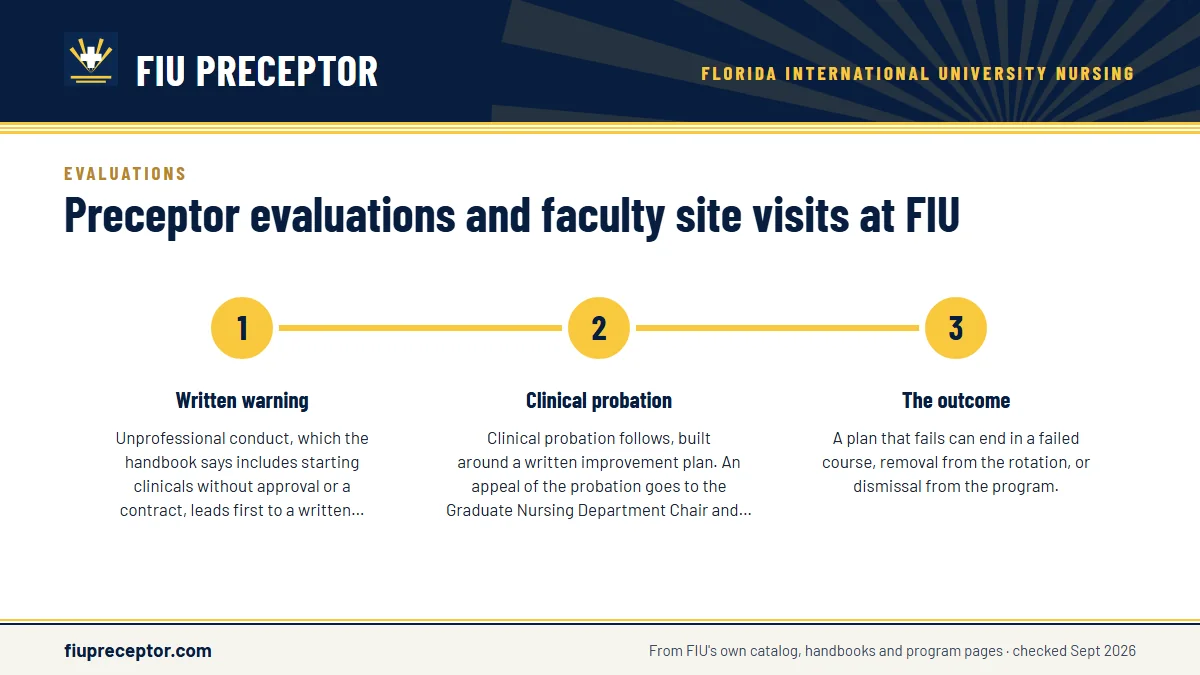
Skill concerns run through feedback and remediation. Conduct is a separate track, with fixed deadlines set out in FIU's graduate handbook. The 48-hour and 5-business-day windows are short, so read your FIU email daily during a rotation, as the handbook already requires.
- Written warningUnprofessional conduct, which the handbook says includes starting clinicals without approval or a contract, leads first to a written warning. You have 48 hours to answer it in writing.
- Clinical probationClinical probation follows, built around a written improvement plan. An appeal of the probation goes to the Graduate Nursing Department Chair and must be filed within 5 business days.
- The outcomeA plan that fails can end in a failed course, removal from the rotation, or dismissal from the program.
The site is on record too
Evaluation runs both ways at FIU. On the Preceptor Request Form, FIU staff record the date of the site's last evaluation along with the preceptor's license and its expiration date. A site FIU has evaluated recently is one the clinical department already knows.
Under FIU's graduate handbook, a new semester can also bring a new site and a new preceptor. If a rotation was a poor fit, say so plainly to your clinical faculty and use the next practicum's request to move somewhere stronger; the Preceptor Request Form page shows what the new request needs. A clear account of what did not work also helps faculty judge which site suits you next. Keep brief notes on each site as the weeks pass, so that feedback is specific when you give it.
Why FIU students choose us for this stretch
We place preceptors who agree up front to what FIU asks of them: a mid-rotation and a final evaluation, two observed faculty visits, contact from FIU faculty between visits, and a time sheet signed as the weeks go by. The evaluation load is part of the first conversation, so it never lands on them by surprise halfway through the term.
When a rotation is not working, we find you a stronger fit for the next practicum, and if a preceptor steps away mid-semester, we start the replacement search at once. Site and preceptor approval belongs to the Office of Clinical Education and your faculty; what we add is a request so complete and so closely matched to FIU's rules that it needs no second round. Start with the form below.
Questions FIU students ask
How many times does my preceptor evaluate me at FIU?
At least twice per rotation. FIU's 2022 preceptor manual has the student set up one preceptor evaluation midway through and a second at the close, on the Appendix C form. Schedule both dates when you set your clinical calendar, so neither one arrives too late to act on.
How many site visits does FIU faculty make?
FIU's 2022 preceptor manual calls for your clinical faculty to watch you on two or more separate clinical days, then complete a site visit evaluation. The graduate handbook adds phone and in-person contact with the preceptor during the semester as needed, so your preceptor may hear from FIU between the two observed days.
Does my preceptor have to be there during the FIU site visit?
Yes. The 2022 manual says both the student and the preceptor must be present, and the clinical faculty arranges the visit with the preceptor. Pick an ordinary clinic day, confirm the date with both of them in writing, and avoid days when your preceptor is off or tied up with administrative work.
What happens after a poor midterm clinical evaluation at FIU?
FIU's graduate handbook says weak performance may lead to a remediation plan that the site and faculty draw up and file in PantherSoft. Use the second half of the rotation to act on the feedback, and keep the stakes in mind: FIU's catalog expects a B (85%) or better in each required course.
Can I switch preceptors after a bad evaluation?
Between semesters, yes: the graduate handbook allows a fresh site and preceptor each term. A change in the middle of a semester is different: it runs through the Office of Clinical Education and your clinical faculty, because a new site needs approval and a contract before any of its hours can count.
Related pages
Last checked 2026-09-26
We check these pages against FIU's own graduate handbook, preceptor manual, plans of study, catalog and licensure pages. Your plan of study, your course faculty, your clinical faculty and FIU's Office of Clinical Education have the final word.
FIU asks you to identify your clinical site. We make that the easy part.
Tell us your FIU track, where you live and which semester your next practicum starts. We find preceptors whose patients fit the course, check early whether the site already holds an FIU contract, and prepare everything the Preceptor Request Form asks for.
- Preceptors matched to the course: adult and older-adult primary care for
NGR 6201L, pediatric primary care forNGR 6301L, an organizational mentor forNGR 7940C - Preceptor, facility, license and schedule details ready for the Preceptor Request Form, weeks ahead of the contract clock
- Across Miami-Dade, Broward, Palm Beach and Monroe, or beyond them where FIU approves your site
Start your placement plan
Track, city and semester is all we need to begin.