Who pays for what in FIU clinical placements
Florida International University (FIU) places several clinical costs on the student: background checks and drug testing, repeat tests included, any extra screening a facility requires, health insurance, your own care after an exposure, and transportation to clinical sites. FIU's graduate pages mention no placement fee, and its 2022 preceptor manual describes preceptors as volunteers.
Get your placement plan
Tell us your FIU program and where you live. A placement advisor replies with the preceptor and site options that fit your FIU course.
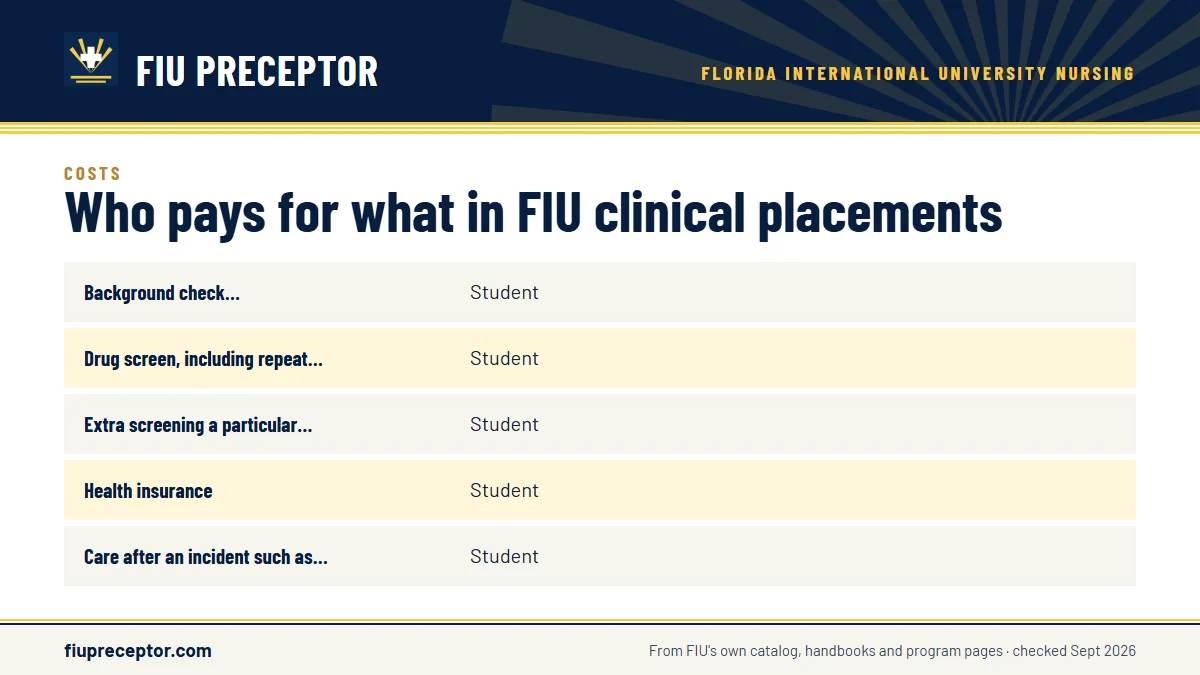
The short answer, item by item
FIU's graduate handbook, its catalog and its manuals say who carries each clinical cost. None of them publishes amounts, and neither does this page.
| Item | Who pays | What FIU says |
|---|---|---|
| Background check, fingerprints, employment verification | Student | The handbook and catalog place background checks on the student; they are ordered through American Databank |
| Drug screen, including repeat testing | Student | Repeat testing is named as a student cost as well |
| Extra screening a particular facility requires | Student | Graduate handbook |
| Health insurance | Student | Major medical with hospitalization, proven every year, or the university plan |
| Care after an incident such as a bloodborne exposure | Student | Your own healthcare costs, per the graduate handbook |
| Transportation to clinical sites | Student | Stated in FIU's catalog |
| Student liability insurance | FIU's documents conflict | Handbook: covered while enrolled; 2022 manual: proof of NP Student Professional Liability Insurance |
| A placement fee from FIU | None mentioned | FIU's MSN, DNP and certificate pages mention no placement fee |
| Preceptor payment | None named | 2022 manual: preceptors are volunteers |
| BSN lab supplies | Student, where charged | The catalog notes a possible fee on BSN courses with an L suffix |
Clearance: the costs that come back
FIU's graduate handbook runs clearance through Complio with American Databank, which FIU's web pages call FIU Express. The Admitted Packages cover the FL VECHS FBI fingerprint search, 7-year employment verification and a 13-panel paperless drug screen, and the handbook and catalog put background checks and drug testing, repeat testing included, on the student.
Renewals are what make clearance a recurring line in your budget: the background check every three years, the drug screen every two years, influenza vaccination and TB testing every year, and the AHA BLS card every two years. Employment verification and FBI fingerprinting are done once. The clearance page lists every item.
For immunizations, titers, TB tests and BLS, the handbook sets the requirement and leaves the paying to you and your coverage. Check what your health plan or your employer's occupational health office already provides before you book anything, and keep every record, since the Immunization Compliance Package asks for proof by dose or titer.
Insurance: health and liability
Health insurance is plainly the student's cost. FIU's graduate handbook requires major medical coverage that includes hospitalization, proven every year, and students without it must enroll in the university plan. The same handbook makes the student responsible for their own healthcare costs after an incident at a site, such as a bloodborne exposure.
Liability insurance is where FIU's documents disagree. The 2025-2026 graduate handbook treats students as covered for as long as they are enrolled in an approved course of study, whereas the 2022 preceptor manual puts NP Student Professional Liability Insurance on its list of required proofs. Ask the Office of Clinical Education which rule applies to your rotation before you buy a separate policy; the insurance and BLS page sets out both versions. Whatever the answer, upload the yearly proof of health coverage on time, since it is one of the clearance items the handbook lists.
Getting to the site and to campus
FIU's catalog puts transportation to clinical sites on the student. Students on the online tracks can train beyond the four home counties, which can mean long drives, and the MSN FAQ says 1-3 campus visits per semester may be required. A site close to home keeps this line small, and the clinicals outside South Florida page covers what to confirm before choosing a distant one.
Nurse Anesthesia is the heavier case. Its 2022 program manual says students cover housing, transportation and meals during clinical assignments, and FIU assigns those sites without promising a location or travel distance. The same manual says students are not charged fees for specific affiliations. The Nurse Anesthesia page covers that program. For any track, count the drive and parking when you compare two possible sites.
What a site can add
A facility can ask for more than FIU does, and FIU's graduate handbook says the student pays for extra screening a particular facility requires. Sites also run onboarding of their own, including training on their electronic health record.
Health systems describe their own steps on their own pages. Baptist Health South Florida's rotation page, for instance, asks for a Complio profile per rotation, submitted no later than 10 business days ahead. Ask each site early what it needs beyond FIU's list, so you order a test once, on time, instead of twice in a hurry. When a site's list overlaps FIU's, ask whether the same result can serve both. Onboarding such as EHR training costs time as well as paperwork, so leave room for it in the weeks before your start date.
Costs you pay in time
Some clinical problems cost weeks rather than money. Logging late in Typhon, beyond the seven-day limit, means repeating the hours. Under the current handbook, a brand-new site agreement needs 6-8 weeks. Missed clinical hours must be made up, and a clinical day on a holiday moves to a replacement day.
The MSN NP tracks start in Fall only, run six semesters and allow no semester off except a Leave of Absence, which under policy 380.048 does not stop the degree clock. A delay in one practicum can therefore move your finish date, and a later finish can mean extra terms of enrollment and another round of clearance renewals. The delayed graduation page covers what to do if that happens to you.
What our service costs, and what you get
Our service has its own quote, separate from anything FIU asks you to pay, and the cost page explains what shapes it. What you get is the most thorough search built around FIU's process: preceptors who fit your course and its patients, in person in your own area, and every piece of information the Preceptor Request Form wants, gathered before it goes in.
We flag early whether a site already holds an FIU contract, track the semester-before timing, your clearance dates and the seven-day Typhon limit, and stay on call to find a replacement if a preceptor drops. Decisions on the site and preceptor stay with FIU's Office of Clinical Education and faculty, and the request we help you send them is finished, accurate and in line with FIU's rules. Share your track and start term in the form below.
Questions FIU students ask
Does FIU charge a clinical placement fee for NP students?
FIU's MSN, DNP and certificate pages mention no placement fee. The DNP Nurse Anesthesia manual says its students are not charged fees for specific affiliations, and the catalog notes a possible lab-supply fee on BSN courses with an L suffix. The clinical costs NP students do carry are clearance, insurance, any extra site screening and travel.
Who covers the cost of FIU's background check and drug screen?
You do. FIU's graduate handbook and catalog place background checks and drug testing, including repeat testing, on the student. They are ordered through American Databank in Complio, which FIU's web pages call FIU Express. The background check renews on a three-year cycle and the drug screen on a two-year cycle, so each comes back during a longer program.
Are preceptors paid by FIU?
In FIU's 2022 preceptor manual, preceptors are volunteers, and no FIU page mentions paying them. The recognition that manual describes is ANCC preceptorship documentation and a Certificate of Participation that exempts tuition fees; the preceptor recognition page explains how each one is earned.
Does FIU cover liability insurance for clinicals?
FIU's documents disagree. The 2025-2026 graduate handbook says enrollment in an approved course of study brings coverage, while the 2022 preceptor manual asks for proof of an NP Student Professional Liability Insurance policy. Ask the Office of Clinical Education which rule applies to your rotation before you buy a policy.
Do I pay for travel to FIU clinical sites?
Yes. FIU's catalog places transportation to clinical sites on the student. Clinicals on the online tracks can sit beyond Monroe, Dade, Broward and Palm Beach counties, which can mean longer drives, and the MSN FAQ says 1-3 campus visits per semester may be required. A site near home keeps this cost down.
Related pages
Last checked 2026-09-26
We check these pages against FIU's own graduate handbook, preceptor manual, plans of study, catalog and licensure pages. Your plan of study, your course faculty, your clinical faculty and FIU's Office of Clinical Education have the final word.
FIU asks you to identify your clinical site. We make that the easy part.
Tell us your FIU track, where you live and which semester your next practicum starts. We find preceptors whose patients fit the course, check early whether the site already holds an FIU contract, and prepare everything the Preceptor Request Form asks for.
- Preceptors matched to the course: adult and older-adult primary care for
NGR 6201L, pediatric primary care forNGR 6301L, an organizational mentor forNGR 7940C - Preceptor, facility, license and schedule details ready for the Preceptor Request Form, weeks ahead of the contract clock
- Across Miami-Dade, Broward, Palm Beach and Monroe, or beyond them where FIU approves your site
Start your placement plan
Track, city and semester is all we need to begin.