Health insurance, liability coverage and BLS for FIU clinicals
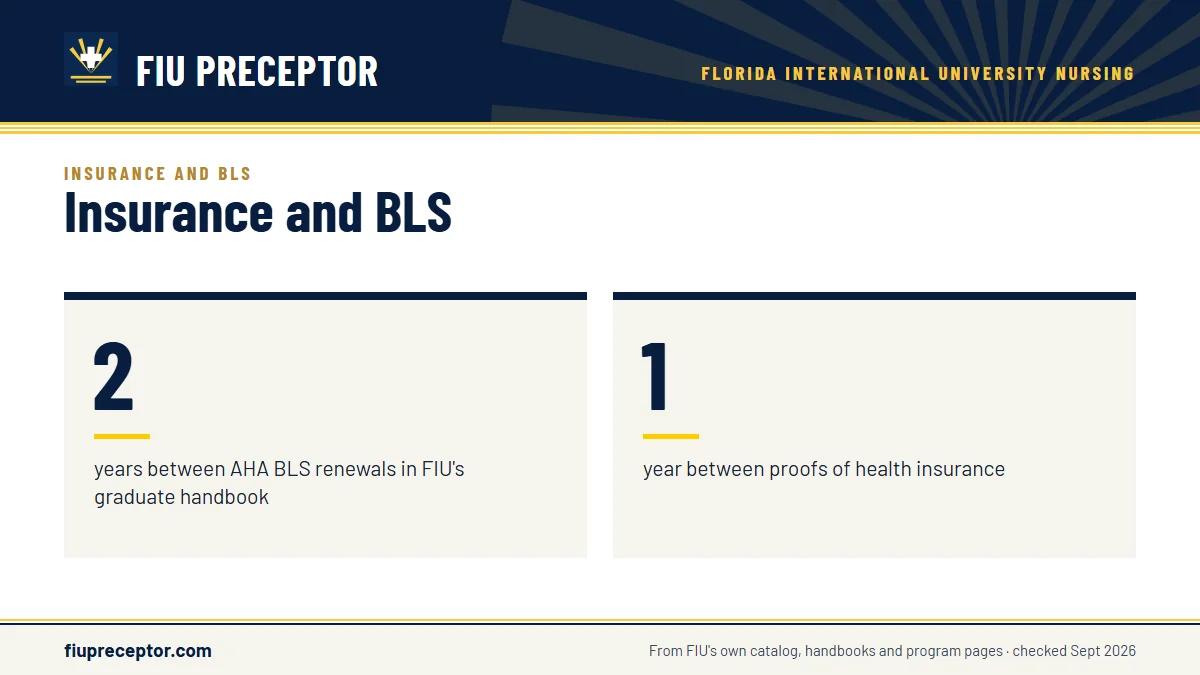
Florida International University (FIU) asks clinical students for three things beyond the screening and immunization packages: major medical health insurance proven every year, an American Heart Association BLS Healthcare Provider card renewed every two years, and liability coverage. The first two are clear. On liability, FIU's own documents disagree: the current graduate handbook says students are covered while enrolled, while the 2022 preceptor manual lists a student policy as a required proof.
Get your placement plan
Tell us your FIU program and where you live. A placement advisor replies with the preceptor and site options that fit your FIU course.
Three requirements, three kinds of rule
These items sit under "other required items" in the Graduate Nursing Student Handbook 2025-2026, alongside the Admitted Packages and the Immunization Compliance Package covered in the clearance overview. Each follows a different logic.
| Item | What FIU's documents say | Cycle |
|---|---|---|
| Health insurance | Major medical coverage including hospitalization; without it, enroll in the university plan (2025-2026 handbook) | Proof every year |
| Liability coverage | Covered while enrolled in an approved course of study (2025-2026 handbook) vs proof of NP Student Professional Liability Insurance (2022 preceptor manual) | Conflict: confirm with FIU |
| BLS | American Heart Association BLS Healthcare Provider card (2025-2026 handbook) | Every two years |
Health insurance protects you. Liability coverage answers for claims that arise from the care you give. BLS is a skill credential. Keeping the three apart in your head makes it easier to answer a site's onboarding questions correctly.
Health insurance: major medical, proven every year
FIU's handbook requires major medical health insurance that includes hospitalization, and it asks for proof every year. Students without coverage must enroll in the university's plan. A plan that covers only clinic visits or preventive care does not meet the hospitalization wording, so check the policy summary before you upload it.
The requirement matters for a practical reason spelled out in the same handbook: the cost of your own healthcare after an incident during clinicals, such as a bloodborne exposure, falls on you. Your health plan is what carries that cost.
Because proof is yearly, the upload date matters more than the plan's renewal date. If your insurance changes mid-program, through a new job or the end of employer coverage, upload the new card and policy details right away rather than waiting for the yearly reminder. Placement costs covers the other expenses the handbook places on students.
Liability coverage: where FIU's documents disagree
FIU gives three different answers depending on which document you read. The current Graduate Nursing Student Handbook 2025-2026 (Rev. April 30, 2026) says students are covered while enrolled in an approved course of study. FIU's clinical preceptor manual for its advanced practice programs, dated 2022, lists NP Student Professional Liability Insurance as a required proof. And FIU Online's information package for RN to BSN students, from Fall 2021, asks them to prove RN liability insurance.
FIU does not reconcile the three. The handbook is the newer document, but the handbook itself points readers to the manual for clinical detail, so both are in circulation.
Settle it in writing for your own term. Ask the Office of Clinical Education, or your course faculty, whether you need an individual student policy and whether a site that asks for a certificate should receive one from you or from FIU.
Neither document settles the liability question for your term on its own: get the Office of Clinical Education's answer in writing before your first rotation.
"Approved course of study": what the handbook's coverage depends on
The handbook ties its liability statement to enrollment in an approved course of study, and FIU's clinical rules define what approved means. Rotations happen only during official semester periods. Clinical days during campus breaks need prior faculty approval by email. Starting clinicals before your site and preceptor are approved and the contract is in place is listed as a conduct violation.
Read together, the message is to keep every clinical hour inside the approved frame: the approved site, the approved preceptor, the official term and, for any break-time work, a faculty email saying yes. Hours outside that frame are outside FIU's rules, whatever else they may mean for coverage.
The site contracts guide explains why the contract must be signed before day one, and the academic calendar lists the official 2026-27 term dates.
AHA BLS every two years
The handbook names a specific card: the American Heart Association BLS Healthcare Provider card, renewed every two years. When you renew, choose a course that issues that card, since FIU names the American Heart Association version.
Two years can end inside your practicum sequence. MSN students on the six-semester plan spend semesters 4, 5 and 6 in practicums, so a card earned before semester 1 can expire during the final one. Look at the expiration date on your card now and compare it with the last day of your final clinical term.
Renew in a break, not in the middle of a rotation. A BLS course takes a day or less, but it is still a day away from a preceptor whose schedule you worked hard to secure.
After graduation: the APRN financial responsibility step
Student coverage ends with the program. When you apply for your Florida APRN license, the Florida Board of Nursing asks for its own proof of financial responsibility: malpractice insurance or an approved exemption. It is one step in the Board's licensing sequence, alongside national certification, the online application and Livescan fingerprints. The Board's review runs up to 30 days, and a gap in the file brings a request back to you, so arrange the policy or the exemption paperwork before you submit.
Autonomous practice registration, for APRNs who later qualify under Florida law, also asks for an updated financial responsibility form at each renewal. For the full path from RN to APRN, see the Florida RN license guide; for protocols and autonomous practice, see how Florida regulates APRN practice.
Why FIU students choose us
We ask every prospective site what it wants to see about insurance and life support before we propose it to you, including whether it expects a student liability certificate, so the question reaches FIU early instead of on your first morning. When your BLS card or insurance proof would run out during a proposed rotation, we tell you before the site is confirmed.
Then we do the rest of the legwork: the preceptor's credentials, the clinic's schedule and address, and a clear answer on whether FIU would need a new contract with that practice. Your faculty and the clinical education office approve; you hand them a request with nothing left blank. If a preceptor drops mid-term, we find a replacement and run the same checks. Our how it works page has the details, and the form on this page reaches a placement advisor.
Questions FIU students ask
Does FIU provide liability insurance for nursing students?
The current graduate handbook says students are covered while enrolled in an approved course of study. The 2022 preceptor manual asks for proof of NP Student Professional Liability Insurance, and the 2021 RN to BSN package asks for proof of RN liability insurance. Ask the Office of Clinical Education in writing which applies to you.
Will FIU accept a BLS card that isn't from the American Heart Association?
FIU's graduate handbook names the American Heart Association BLS Healthcare Provider card specifically, renewed every two years. If you hold a different provider's card, raise it with the Office of Clinical Education before relying on it, or take an AHA course that issues the named card.
What if I don't have health insurance as an FIU nursing student?
FIU's handbook says students without major medical coverage that includes hospitalization must enroll in the university's plan. Proof is required every year. The handbook also places your own healthcare costs after a clinical incident, such as a bloodborne exposure, on you, which is why the coverage matters.
How often do I renew BLS for FIU clinicals?
Every two years. Check the expiration date against the last day of your final practicum term; on the six-semester MSN plan, a card earned before the program starts can run out during the last practicum. Renew during a break between terms so the course does not cost you a clinical day.
Related pages
Last checked 2026-09-26
We check these pages against FIU's own graduate handbook, preceptor manual, plans of study, catalog and licensure pages. Your plan of study, your course faculty, your clinical faculty and FIU's Office of Clinical Education have the final word.
FIU asks you to identify your clinical site. We make that the easy part.
Tell us your FIU track, where you live and which semester your next practicum starts. We find preceptors whose patients fit the course, check early whether the site already holds an FIU contract, and prepare everything the Preceptor Request Form asks for.
- Preceptors matched to the course: adult and older-adult primary care for
NGR 6201L, pediatric primary care forNGR 6301L, an organizational mentor forNGR 7940C - Preceptor, facility, license and schedule details ready for the Preceptor Request Form, weeks ahead of the contract clock
- Across Miami-Dade, Broward, Palm Beach and Monroe, or beyond them where FIU approves your site
Start your placement plan
Track, city and semester is all we need to begin.