Who can precept an FIU nurse practitioner student
Florida International University (FIU) asks for a preceptor with at least one year of professional experience in the field or specialty, active professional licensure and national certification. Florida adds a rule of its own: in a Florida setting the preceptor must hold a Florida license. Below are the review FIU runs, the physician question its handbook leaves open, and the people it rules out.
Get your placement plan
Tell us your FIU program and where you live. A placement advisor replies with the preceptor and site options that fit your FIU course.
FIU's baseline for every NP preceptor
The 2025-2026 Graduate Nursing Student Handbook sets three minimums before FIU looks at anything else.
What the graduate handbook asks for
- At least one year of professional experience in the field or specialty you are training in.
- Active professional licensure.
- National certification.
Beyond those minimums, FIU reviews each prospective preceptor on educational background, professional experience, state and national certification as an NP and/or CNS, nursing philosophy and willingness to precept. The last item is the one you can influence directly: explain the time and the paperwork involved before the preceptor commits, so the yes is an informed one.
These checks attach to the clinician who supervises you, not just to the practice. If a practice offers to rotate you among several clinicians, each one who precepts you should meet the same minimums, so ask your faculty how to list them on the request.
Florida's licensing rule for preceptors
Florida adds its own floor. Under Board of Nursing rule 64B9-4.001(13), the people who can serve as an NP student's qualified preceptor are practicing, certified APRNs, physicians (MD or DO) and dentists, each responsible for supervising, teaching and evaluating you on site. For a site located in Florida, the rule requires that preceptor to hold a Florida license, and requires you to hold an RN license issued under chapter 464.
You already meet the student side, because FIU requires a current Florida RN license for its graduate NP programs, as the Florida RN license page explains. For a site in another state, FIU does not say what license either party needs, so raise it with the Office of Clinical Education before committing. The wider Florida picture, protocols and autonomous practice included, is on Florida APRN practice and preceptors.
Nurse practitioners, physicians and the master's rule
The handbook expects nurse practitioners to supervise the bulk of your rotations and allows physician preceptors as well; the MSN Clinical Education page names both NPs and physicians. Florida's rule also counts MDs and DOs as qualified preceptors.
There is a catch FIU leaves unresolved. The same handbook states that a master's degree in nursing is required of preceptors, which a physician would not hold. FIU does not explain how the two statements fit together, so if your strongest candidate is a physician, get your clinical faculty's view before the Preceptor Request Form goes in rather than after.
Physician assistants are not mentioned in FIU's handbook or preceptor manual. Raise a PA candidate with your faculty and with the clinical education office before approaching them, and treat the answer you get as the rule for your rotation.
Who is ruled out
People and settings FIU's handbook excludes
- Family members and close friends, as preceptors.
- The unit where you work; at a large institution, a different unit is allowed.
- Hospital rounds in place of precepted care: you may observe rounds only when the preceptor is not an employee, observation stays minimal, and it does not count toward practicum hours.
The workplace rule has more nuance for students who hope to train at their employer, and for DNP students whose residency hours may fall at their job site; the working where you work guide covers both. When one clinician is ruled out, the practice may still work with a different clinician there, as long as none of these limits applies. If you are unsure whether a relationship counts as close, disclose it on the request and let your faculty decide.
DNP mentors and RN to BSN preceptors
DNP residency hours use an organizational mentor rather than a clinical preceptor. Ideally, per the handbook, the mentor holds a doctorate and is expert in your area. Your usual work supervisor cannot be the mentor of record, and residency hours at your job site count only when they sit outside your normal duties and scheduled shifts. The organizational mentor guide covers the approval step.
RN to BSN preceptors follow the BSN handbook: a nurse with a BSN, at a site holding a current NWCNHS contract, approved by faculty with no conflict of interest. The preceptor cannot be at your exact work location or unit, paid time does not count toward clinical hours, and nurse practitioners or clinical nurse specialists working solely as primary care providers are not approved for NUR 4945L.
A quick screen before you ask
If your preceptor already supervises another student, ask your faculty how FIU handles it, because FIU publishes no preceptor-to-student ratio. The same goes for any candidate who fits most of the table but not all of it: a short question before filing costs far less time than a request that has to be withdrawn.
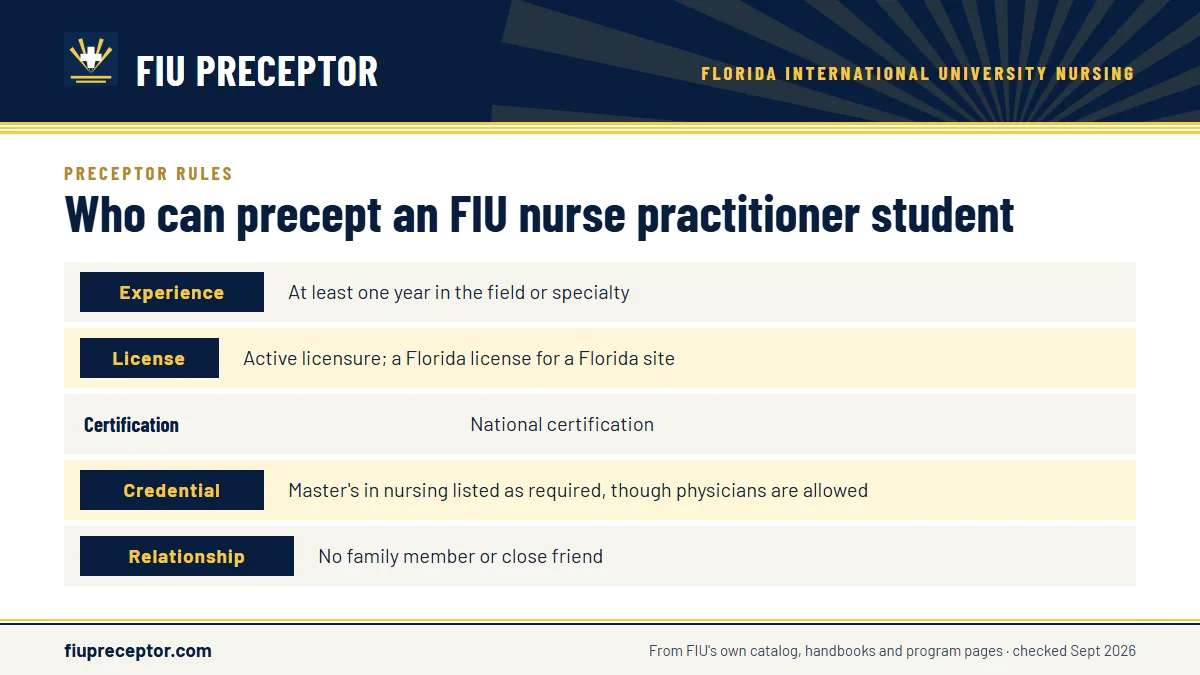
| Check | Rule | Source |
|---|---|---|
| Experience | At least one year in the field or specialty | FIU graduate handbook |
| License | Active licensure; a Florida license for a Florida site | FIU handbook; rule 64B9-4.001(13) |
| Certification | National certification | FIU handbook |
| Credential | Master's in nursing listed as required, though physicians are allowed | FIU handbook, unreconciled |
| Relationship | No family member or close friend | FIU handbook |
| Workplace | Not your own unit | FIU handbook |
| Patients | Adult and older-adult, or pediatric, primary care to match your course | MSN plan of study |
How we vet preceptors for FIU students
Before you hear a preceptor's name from us, we have already screened them against this list: years in the specialty, an active Florida license with its expiration date for a Florida site, national certification, and a patient mix that fits NGR 6201L or NGR 6301L. We confirm there is no family or workplace conflict and that the preceptor understands FIU's paperwork, from the folder at the first meeting to the evaluations and faculty visits.
When a candidate touches one of FIU's open questions, such as a physician under the master's rule, we flag it so you can raise it with your faculty before the request is filed. Every preceptor still needs approval from FIU's faculty and clinical education office; ours arrive already matched to FIU's rules. Clinicians thinking about hosting a student can read precepting an FIU student.
Questions FIU students ask
Does my FIU preceptor need to be a nurse practitioner?
Not necessarily. FIU's handbook allows nurse practitioner or physician preceptors and says most of your rotations will be with NPs. Because the same handbook also lists a master's in nursing as required, confirm a physician preceptor with your clinical faculty before you submit the request, and keep the answer in writing.
Does a preceptor at a Florida site need a Florida license?
Yes. Under Board of Nursing rule 64B9-4.001(13), a qualified preceptor at a Florida site has to be licensed by Florida, whatever other licenses they hold. A clinician practicing in the state should already have one; check it and its expiration date before your request goes in, because FIU staff write both on the form.
Do FIU preceptors get paid?
FIU's 2022 preceptor manual describes preceptors as volunteers. What it offers instead is recognition: ANCC preceptorship documentation after at least 120 hours with NWCNHS advanced practice students, and, at 300 hours, a Certificate of Participation that exempts tuition fees for up to six credit hours in one term. The preceptor recognition page has the conditions.
How much experience does an FIU preceptor need?
At least one year of professional experience in the field or specialty, according to FIU's graduate handbook, together with active licensure and national certification. FIU then weighs education, experience, NP or CNS certification, nursing philosophy and willingness to precept, so a clinician just past the one-year mark can still qualify.
Can my preceptor be a former colleague?
FIU's handbook rules out family members and close friends and bars rotating on the unit where you currently work. A former colleague is not named in either rule, so describe the relationship plainly to your clinical faculty, who reviews the request, and let them judge whether it creates a conflict.
Related pages
Last checked 2026-09-26
We check these pages against FIU's own graduate handbook, preceptor manual, plans of study, catalog and licensure pages. Your plan of study, your course faculty, your clinical faculty and FIU's Office of Clinical Education have the final word.
FIU asks you to identify your clinical site. We make that the easy part.
Tell us your FIU track, where you live and which semester your next practicum starts. We find preceptors whose patients fit the course, check early whether the site already holds an FIU contract, and prepare everything the Preceptor Request Form asks for.
- Preceptors matched to the course: adult and older-adult primary care for
NGR 6201L, pediatric primary care forNGR 6301L, an organizational mentor forNGR 7940C - Preceptor, facility, license and schedule details ready for the Preceptor Request Form, weeks ahead of the contract clock
- Across Miami-Dade, Broward, Palm Beach and Monroe, or beyond them where FIU approves your site
Start your placement plan
Track, city and semester is all we need to begin.