Florida APRN practice rules and who can precept you
Florida nurse practitioners work under a written protocol with a physician unless they have registered for autonomous practice, an option limited to primary care. Board rule 64B9-4.001(13) lets APRNs, physicians and dentists precept NP students, and insists that anyone precepting at a Florida site be licensed in Florida. This guide explains how those rules shape a Florida International University (FIU) student's search and what you will see of them in clinic.
Get your placement plan
Tell us your FIU program and where you live. A placement advisor replies with the preceptor and site options that fit your FIU course.
Protocol practice: how most Florida NPs work
Florida's default is a protocol. Under s. 464.012(3), an APRN practices within an established protocol kept on site at each practice location, unless registered for autonomous practice. The Board lists filing that protocol at the practice location as a step after the license is issued, and its old protocol-standards rule, 64B9-4.010, is now repealed, so the requirement rests on the statute itself.
The physician's role is defined in rule 64B9-4.001(14) as general supervision: the supervising MD, DO or dentist authorizes the procedures but does not need to be in the room, only reachable for consultation. AANP lists Florida as a restricted practice state and notes that certain Florida NPs remain tied to a physician protocol throughout their careers. For you, that means a preceptor may mention a collaborating physician whose protocol shapes how the clinic runs.
Autonomous practice: a primary care exception
Section 464.0123 creates a second path. An APRN may register for autonomous practice, but only in primary care, which the statute describes as family medicine, general internal medicine and general pediatrics, and which the Board's rule stretches to cover behavioral and mental health. To register, the APRN needs:
- an unrestricted Florida APRN license in good standing;
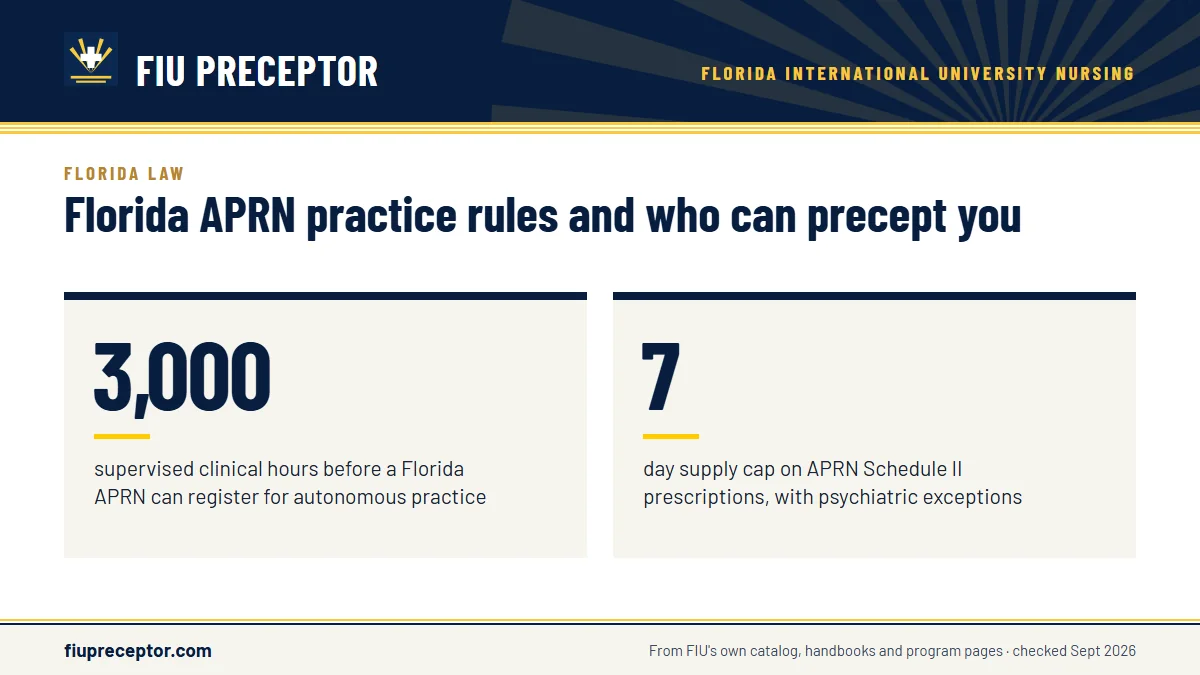
- 3,000 or more hours of physician-supervised clinical practice in the last five years, where time spent teaching as clinical faculty can count;
- graduate coursework in pharmacology and in differential diagnosis, three semester hours of each, finished inside that same five-year window;
- five years with no disciplinary action.
Rule 64B9-4.020 treats three graduate semester hours as 45 CE credits, and each renewal of the registration needs 10 more graduate-level CE credits plus an updated financial responsibility form. Because FIU's AGPCNP and PNP tracks are primary care tracks, some preceptors you meet may practice this way.
Who counts as a qualified preceptor in Florida
Rule 64B9-4.001(13), last amended in February 2021, names three kinds of qualified preceptor: certified practicing APRNs, physicians holding an MD or DO, and dentists. Whichever it is, that person oversees your patient care on site, teaches you and grades your performance. The rule speaks of certified practicing APRNs generally, so an NP under a protocol and one registered for autonomous practice both fit its wording.
Put the clinic inside Florida and both people need Florida standing: a Florida license for the preceptor, and for you an RN license issued under the state's nurse practice act, chapter 464. FIU already requires a current Florida RN license, as the Florida RN license guide explains. Florida's rules are silent on whether a school or its student has to line up the preceptor, which is why FIU's own instruction decides that question.
FIU's standards on top of the state rule
The state rule is a floor, and FIU builds on it. In FIU's graduate handbook, a preceptor brings at least one year of professional practice in the specialty, a license in active status and national certification. FIU also weighs each candidate's schooling, clinical background, certification as an NP or CNS, philosophy of nursing and appetite for teaching, and it tells students that nurse practitioners will precept most of their rotations.
Two of the state rule's categories need care at FIU. Physicians are welcome in FIU's own words, yet the same handbook lists a master's degree in nursing as a requirement, and FIU does not reconcile the two. Dentists appear in the Board's definition, while FIU's own documents speak of NP and physician preceptors. Before relying on anyone outside nursing, get your clinical faculty's approval in writing. The preceptor requirements guide lists the rest of FIU's rules.
Prescribing rules you will see in a Florida clinic
Controlled-substance rules shape daily practice. Rule 64B9-4.016 lets APRNs prescribe controlled substances only within their education, training, experience and protocol, caps Schedule II prescriptions at a 7-day supply (psychiatric medications prescribed by a psychiatric nurse are exempt), and reserves psychiatric controlled substances for patients under 18 to psychiatric nurses.
For acute pain, rule 64B9-4.017 requires written justification to go beyond the 3-day limit on Schedule II opioids. E-FORCSE, Florida's prescription drug monitoring database, must be consulted before any controlled substance is prescribed or dispensed for someone 16 or over; nonopioid Schedule V drugs and hospice patients are the exceptions. Every biennial renewal carries at least 3 hours of CE on controlled-substance prescribing, and an APRN who dispenses medication files a separate application under rule 64B9-4.011.
Recent Florida changes worth knowing
Florida's APRN rules have shifted several times since 2024, as the Board's and the Department of Health's bill summaries show.
| Year | Bill | What changed |
|---|---|---|
| 2024 | HB 975 | Fingerprint background screening for all practitioners, effective July 1, 2025 |
| 2024 | SB 7016 | Areas of Critical Need opened to APRNs; the TEACH funding program created |
| 2024 | HB 7021 | Limits on APRNs treating the physical health of psychiatric patients removed |
| 2024 | HB 935 | APRNs may order Medicaid home health services |
| 2025 | HB 647 | Hospice APRNs under a physician protocol may file death certificates |
| 2026 | HB 809 | A critical-need temporary certificate stays valid after the area loses its designation, if the APRN keeps an active primary care relationship there |
| 2026 | HB 1443 | APRNs report Parkinson's cases to a state registry from January 1, 2027 |
| 2026 | HB 301 / SB 138 | Did not pass: autonomous psychiatric practice without a protocol |
After graduation, and how we use these rules now
The Florida APRN license comes after your FIU program: an RN license, the finished graduate program, proof of national certification forwarded directly from the certifying body, an online application, Livescan fingerprints and proof of financial responsibility, then a protocol on file where you practice. The RN license guide sets out the order, and the Florida NP preceptors guide covers what health systems add.
While you are a student, these rules decide who can precept you. We confirm each candidate's Florida license and its expiration, national certification and time in the specialty, and we flag any preceptor outside nursing for your faculty's decision before you commit. Approval stays with FIU: your faculty and the clinical education office sign off on the site and preceptor, and the request they receive already fits both the Board's rule and FIU's handbook. Send your track, course and county through the form below to begin.
Questions FIU students ask
Is an NP on a physician protocol allowed to precept me?
Yes. Florida's preceptor definition covers certified practicing APRNs without separating protocol practice from autonomous practice, and protocol practice is the state's default. What matters for FIU is a current Florida license, national certification as an NP, twelve months or more in the specialty and your faculty's approval.
When can a new Florida NP practice autonomously?
Only after 3,000 hours of physician-supervised clinical practice inside the last five years, plus graduate pharmacology and differential diagnosis coursework, three semester hours of each, in that window. The APRN also needs a clear Florida license and no recent discipline, and the registration covers primary care only, which Board rule reads to include behavioral and mental health.
Can a dentist precept an FIU NP student?
Florida's rule lists dentists among qualified preceptors, but FIU's own documents describe NP and physician preceptors and expect most rotations to be with NPs. Whether a dentist could supervise a primary care practicum is your clinical faculty's call, so any such arrangement needs their explicit approval before it goes on the Preceptor Request Form.
Does Florida require nursing schools to find NP preceptors?
No Florida rule assigns the task to either the school or the student. The Board's program-approval statute covers prelicensure programs, and its preceptor rule defines who qualifies without saying who arranges the placement. At FIU, the online primary care tracks put identifying the site on the student.
Related pages
Last checked 2026-09-26
We check these pages against FIU's own graduate handbook, preceptor manual, plans of study, catalog and licensure pages. Your plan of study, your course faculty, your clinical faculty and FIU's Office of Clinical Education have the final word.
FIU asks you to identify your clinical site. We make that the easy part.
Tell us your FIU track, where you live and which semester your next practicum starts. We find preceptors whose patients fit the course, check early whether the site already holds an FIU contract, and prepare everything the Preceptor Request Form asks for.
- Preceptors matched to the course: adult and older-adult primary care for
NGR 6201L, pediatric primary care forNGR 6301L, an organizational mentor forNGR 7940C - Preceptor, facility, license and schedule details ready for the Preceptor Request Form, weeks ahead of the contract clock
- Across Miami-Dade, Broward, Palm Beach and Monroe, or beyond them where FIU approves your site
Start your placement plan
Track, city and semester is all we need to begin.