Connecticut residents and FIU's online nursing tracks
Connecticut is the newest compact state on this list, honoring multistate RN licenses only since October 1, 2025. Florida International University (FIU) treats Connecticut, like every state except Florida, as undetermined for licensure, asks MSN applicants for a Florida RN license, and is silent on online-track rotations in Connecticut. Start with those three answers.
Get your placement plan
Tell us your FIU program and where you live. A placement advisor replies with the preceptor and site options that fit your FIU course.
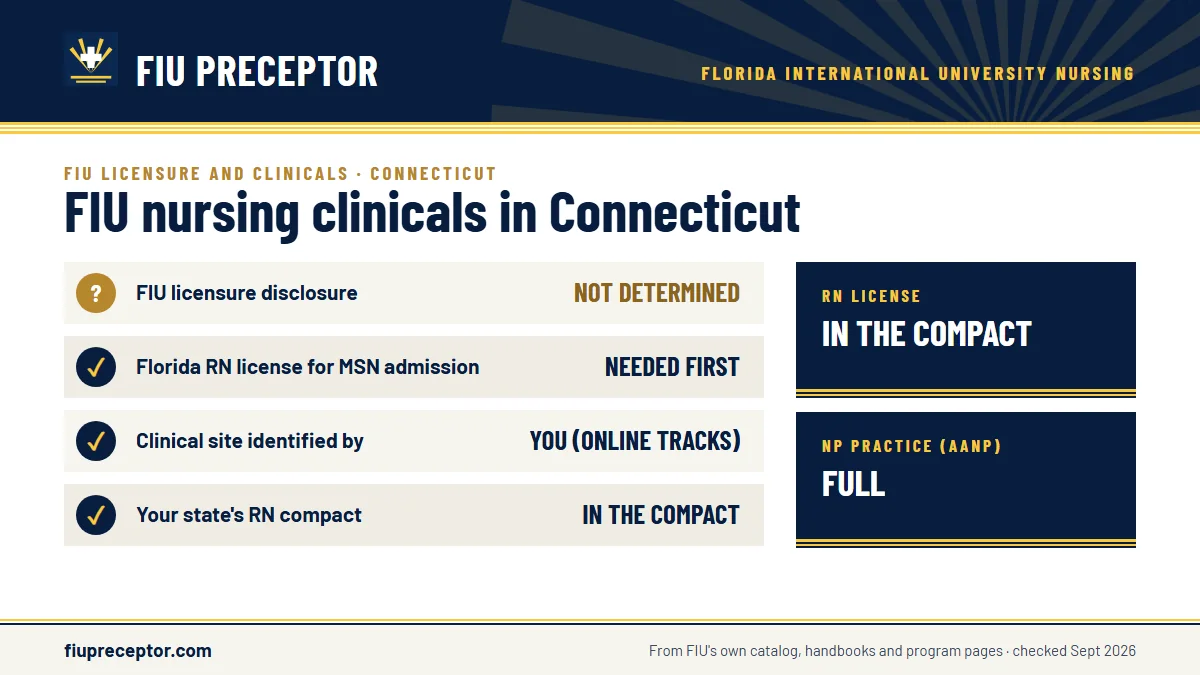
A compact state since October 2025
Until the autumn of 2025, working as a nurse in Connecticut meant holding a Connecticut license. On October 1 of that year the state joined the compact, and its Department of Public Health now lets RNs work there on a multistate license from their home state too. Florida's membership goes back to 2018.
That change matters at the bedside, but FIU's admission rule is its own matter. The MSN names a current Florida RN license, and FIU is silent on whether a multistate license with Connecticut as your home state would do. Read our Florida RN license page and ask admissions for a written answer. Advanced practice is untouched, since Connecticut sits outside the APRN Compact.
FIU's side of the ledger
- Licensure: Florida is the one state FIU speaks for. Connecticut is left undetermined, and FIU tells students bound for a license there to contact the state's licensing agency first. See the licensure disclosure.
- Clinical reach: students on the online primary care tracks find their own sites, which may lie outside FIU's home counties in South Florida, and start only once FIU's contract is signed. Whether that reach crosses into Connecticut is unstated.
- Location: under Policy 1370.001, the address you report to FIU sets your learner location, and it changes only through a formal update.
Taken together, the list points to one first step: a written question to FIU's Office of Clinical Education about a Connecticut site for your track, sent before you contact any practice.
Connecticut's regulations for programs from elsewhere
Connecticut's approach to out-of-state schools rests on recognition rather than paperwork. Regulation 20-90-59 treats a program from another state as deemed approved provided the program answers to an approving board at home, its courses satisfy Connecticut's RN curriculum rule, and the licensing bar back home is similar to Connecticut's or higher. No extra filing appears in the text.
Clinical teaching inside Connecticut agencies comes with conditions. Written contracts are required, ratios apply (each preceptor is limited to a pair of students), and faculty teaching on site need a Connecticut RN license, both a bachelor's and a master's with at least one of them in nursing, and experience in their field. All of this sits in rules for programs leading to initial licensure, leaving APRN and RN to BSN programs unaddressed, so the Board of Examiners for Nursing is the office to ask about an FIU NP rotation.
Preceptors, practice rules and where students look
Regulation 20-90-51(f) sets the bar for anyone precepting advanced-level students in RN education programs: a current RN license issued by Connecticut or by whichever state hosts the precepting, a nursing bachelor's, and a two-year track record in the specialty. FIU adds its own preceptor requirements. AANP classes Connecticut as full practice, a status an NP reaches once 2,000 hours spread over three years of physician collaboration are behind them.
Metro Hartford is the biggest population center, the Bridgeport-Stamford-Danbury corridor comes next, and New Haven and the Waterbury-Shelton area follow. Students there tend to research Yale New Haven Health, for example, or Hartford HealthCare in the capital region; Trinity Health Of New England; UConn Health; and, out west, Northwell Health, the New York-based system now operating Danbury Hospital and other former Nuvance sites. Each makes its own call on visiting students, and FIU contracts with any site first.
Our work for FIU students in Connecticut
Connecticut students get a search that respects both FIU's rules and the state's. We look for preceptors whose licenses and experience clear FIU's bar and Connecticut's, match them to your practicum, find out early whether a practice would be new to FIU, and prepare every detail FIU's request form asks for. Tell us about your term.
Questions FIU students ask
Does Connecticut's move into the compact mean FIU will accept my license?
Not by itself. The compact decides where you may work as an RN, while FIU's MSN admission rule is a separate test. FIU asks for a current Florida RN license and has not addressed multistate licenses from other compact states for the MSN, so get a written answer from graduate nursing admissions before you count on one.
Can I use a Yale New Haven or Hartford HealthCare practice for FIU clinicals?
Only if FIU agrees to a Connecticut rotation for your track, the system takes students from universities in other states, the preceptor meets FIU's standards, and FIU signs a contract with the site. A brand-new FIU contract can take 6-8 weeks by the current handbook's reckoning, so raise the question early.
Must I hold Connecticut's own RN license during clinical hours there?
For RN practice, Connecticut now accepts a multistate license from your own compact state of residence, alongside its own license. FIU's admission requirement stands apart and still points to a Florida RN license, so some students end up holding more than one license at once.
Who precepts FIU pediatric students in Connecticut?
FIU looks for pediatric primary care NPs or physicians who have practiced a year or longer in the specialty, with active licensure and national certification. Connecticut's regulation for advanced-level students asks for two years. A preceptor who meets the longer of the two satisfies both sets of rules.
Related pages
Last checked 2026-09-26
We check these pages against FIU's own graduate handbook, preceptor manual, plans of study, catalog and licensure pages. Your plan of study, your course faculty, your clinical faculty and FIU's Office of Clinical Education have the final word.
FIU asks you to identify your clinical site. We make that the easy part.
Tell us your FIU track, where you live and which semester your next practicum starts. We find preceptors whose patients fit the course, check early whether the site already holds an FIU contract, and prepare everything the Preceptor Request Form asks for.
- Preceptors matched to the course: adult and older-adult primary care for
NGR 6201L, pediatric primary care forNGR 6301L, an organizational mentor forNGR 7940C - Preceptor, facility, license and schedule details ready for the Preceptor Request Form, weeks ahead of the contract clock
- Across Miami-Dade, Broward, Palm Beach and Monroe, or beyond them where FIU approves your site
Start your placement plan
Track, city and semester is all we need to begin.